
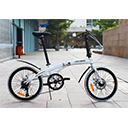
Xe đạp gấp - xedapgap.org
ID
kenfadikalmjghcbgnieimollinhmcllWe specialize in folding bicycles that can be put in a car or conveniently stored in small spaces such as a corner of a home or office.
Penerangan
We specialize in folding bicycles that can be put in a car or conveniently stored in small spaces such as a corner of a home or office.
The advantages and folding mechanisms of folding bicycles
Although road vehicles such as cars and motorcycles continue to develop today, that does not mean bicycles are no longer popular. Recently, in particular, a new type of bicycle has appeared and shaken up the vehicle market, not only in Vietnam but around the world. What kind of bicycle is it? What advantages does it have? How does its mechanism work, and why has it attracted so much attention? The special means of transport I am referring to is the folding bicycle and its folding mechanism.
Advantages of folding bicycles:
- Compact transportation: The first advantage is that these vehicles are compact and made from ultra-light materials. Their size can be reduced by folding, making them especially convenient to carry or store. They do not cause traffic congestion.
- Excellent exercise for health: Cycling is a very good form of exercise. Cycling regularly can maintain and improve your health and give you a balanced, toned physique.
- Environmentally friendly: Because the bicycle operates entirely mechanically, it produces none of the smoke, dust or harmful emissions associated with gasoline- or diesel-powered vehicles.
- Saves money: Using a folding bicycle can save a considerable amount because there is no need to pay for fuel, maintenance, parking, road maintenance fees and so on.
Folding bicycle mechanisms:
The folding mechanism, difficulty, time required and degree of secure fastening vary by model. The following are folding mechanisms used on folding bicycles.
- Triangle hinge folding:
With this mechanism, the hinge is positioned on the frame so that the wheel and frame triangle swing forward and fold down beneath the main frame tube, as on the Brompton Mezzo Folder, Bike Friday or Swift Folder. Triangle hinge folding also has many variations depending on the model.
- Mid-frame or half folding:
Some folding frames follow the design of a traditional bicycle frame but add folding features with single or double hinges. This allows the bicycle to be folded neatly in half. The handlebars and saddle can be adjusted up or down using locking catches. The wheels on this type of folding bicycle can be as large as those on conventional bicycles.
- Folding with a magnetic folding and suspension system:
The folding mechanism is formed by integrating magnets into the rear suspension. Specifically, magnets are attached to the rear wheel lock and frame. When the magnets are disconnected, the bicycle folds in half, and after one second the rear wheel automatically folds forward for vertical folding without any manual action.
- Vertical folding:
This type of bicycle folds vertically rather than horizontally. To make this possible, manufacturers design one or two hinges near the chain and saddle or along the main frame tube, allowing the bicycle to fold vertically with ease. With this design, the two wheels fold into positions beside each other. This mechanism makes the folded bicycle more compact than horizontal folding.
- Folding by disassembly and other variations:
With this mechanism, you can detach part of the bicycle to put it in a suitcase and fold the bicycle, which is convenient for travel.
Other variations include:
+ Gekko: This mechanism folds from the seat tube like an inverted umbrella.
+ Bicycle Torque Coupling: This is a proprietary connection system installed on a standard bicycle frame.
+ Giatex: A pulling or folding mechanism for adjusting the bicycle's size.
These mechanisms generally cost more in time and money and are also heavier.
Whether a bicycle can be folded compactly also depends on wheel size. Therefore, people who prefer compact, lightweight bicycles usually choose smaller wheels. The three main wheel sizes are 16, 18 or 28 inches. However, smaller wheels do not necessarily mean a lighter bicycle, as weight also depends on the materials used for each model.